Most readers never think about editing unless something goes wrong. A missing word, a stray typo, or a sentence that makes no sense will pull attention to the surface and remind the reader that the story exists as text on a page. When that happens, immersion breaks. The illusion slips. The reader leaves the world of the book and lands back in the room where they started.
That reaction feels obvious, which is why so many people assume editing lives almost entirely in spelling and grammar. The image of the editor still comes with red pens and corrected commas, with someone quietly hunting for mistakes while the real work of storytelling happens somewhere else. Those details matter, and no book should ship with errors scattered across the page, but they form the smallest and most visible layer of the job.
What Readers Think Editing Is
Readers notice mistakes because mistakes announce themselves. Their, there, and they’re interrupt the flow of a sentence that otherwise would have carried the eye forward without friction, while your and you’re manage the same sabotage with even less effort. A missing apostrophe can twist meaning sideways for a moment, and a swapped homophone can turn tension into confusion before the reader understands what happened. These slips earn attention because they force the reader to stop and repair the sentence in their head before moving on. Professional style guides exist largely to prevent exactly this kind of interruption.
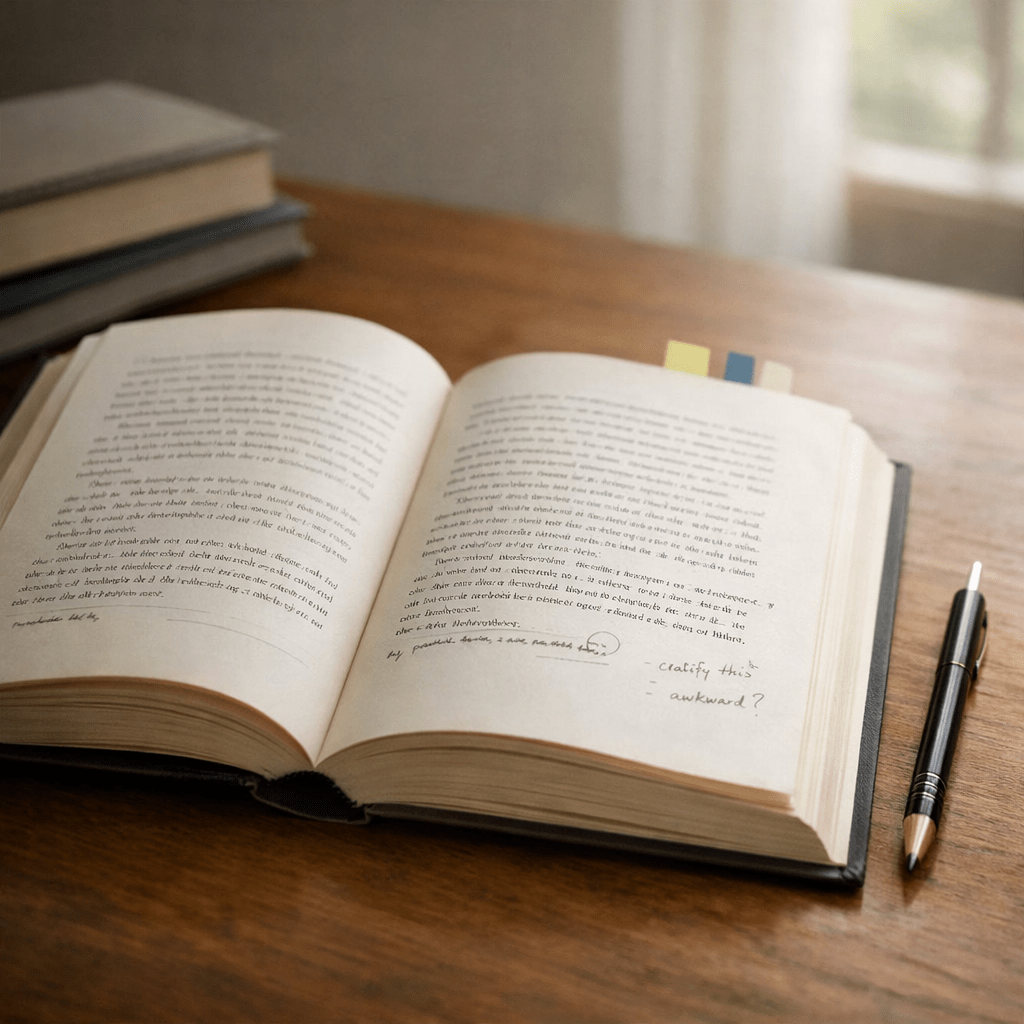
For many people, that moment becomes the definition of editing. The job turns into the hunt for the obvious error, the quiet patrol for typos, the person who circles the wrong word and writes “check this” in the margin. Somewhere in the background, a red pen waits patiently to rescue lines like “your going to regret this” before the villain accidentally confesses illiteracy in the middle of a threat. Editing becomes a matter of catching what looks wrong and moving on, while the rest of the work fades from view because no one ever sees it.
That picture makes sense because these are the only edits that ever reveal themselves to the reader. A sentence that reads “there sword lay on the table” forces a pause while the mind decides who owns the weapon before the scene can continue. A confession that promises “your the only one I trust” quietly turns intimacy into a grammar lesson at exactly the wrong moment. Even a line as simple as “they’re coming for there friend” can scatter attention so completely that the meaning struggles to recover.
Because these errors refuse to stay invisible, grammar attracts more attention than any other part of the process. It feels like the entire problem because it is the only layer of the work the reader ever catches in the act, and the only one that announces itself loudly enough to be remembered.
The trouble is that this layer barely scratches the surface.
Where the Real Work Happens
In reality, editors spend far more time fixing things that never call attention to themselves. The heart of the job lives in places where the writing almost works, where the story almost flows, and where the reader almost believes. Small inconsistencies hide inside those moments and quietly weaken the experience without leaving a clear mark behind.
A character may react to information they should not know yet. A scene may shift location without offering a clean bridge. A line may drift out of the character’s voice and into the author’s habits for half a paragraph before finding its way back again. None of these problems look dramatic on the page, yet each one creates a tiny moment of instability that the reader feels long before they recognize it.
Editing exists to remove that instability.
Protecting Clarity, Continuity, and Voice
Clarity sits at the center of this work. When a reader loses track of who speaks, where the scene takes place, or why an action matters, confusion arrives first and trust follows it out the door. Editors watch for these moments carefully because clarity does not repair itself. Once a reader has to stop and reconstruct the scene, the spell has already broken.
Continuity creates a similar risk. Time slips forward too fast or stalls too long. Details change without explanation. A minor object appears in one chapter and disappears in the next. These errors rarely trigger conscious annoyance, yet they weaken the sense that the world on the page obeys its own rules. Editing restores those rules before the reader ever realizes they were missing.
Voice control matters just as much. A novel promises intimacy, perspective, and consistency, yet voice drifts easily when drafts pile up and revisions stack on top of revisions. An editor notices when a sentence suddenly sounds older, flatter, or more formal than the character who speaks it. Quiet corrections bring the narration back into alignment so the reader never feels the shift.

Shaping Rhythm and Pacing
Pacing shapes the experience in even subtler ways. A scene that lingers half a page too long drains tension without making noise. A transition that moves too quickly leaves the reader unanchored without offering a clear complaint. Editing smooths those edges by trimming weight, redistributing emphasis, and restoring rhythm before the imbalance becomes obvious.
Most of this work disappears the moment it succeeds.
Readers rarely think about rhythm unless it fails. Sentence weight either carries the eye forward or it does not. Paragraph flow either guides attention or scatters it. Emotional pacing either builds pressure or releases it too early. Editors adjust all of this quietly by moving phrases, reshaping lines, and tightening transitions until the prose stops calling attention to itself.
Good editing does not make writing impressive. It makes writing invisible. A neat little oxymoron that explains the entire profession in two sentences.
Why This Matters More Than Perfect Grammar
That invisibility explains why grammar receives so much credit. A book can survive a typo. Many readers will forgive a stray error if the story continues to hold them. Confusion, however, erodes patience quickly. Broken immersion drains trust. A reader who no longer feels safe inside the narrative will not keep going long enough to admire the craft.
What readers remember is not technical cleanliness. They remember how the book felt. They remember whether the world held steady, whether the voice stayed true, and whether the story carried them without asking for effort.
What Editors Are Really Protecting
Writers often imagine editing as correction, yet protection describes the work more accurately. Editors protect voice from drift, characters from inconsistency, pacing from imbalance, and logic from collapse. They remove obstacles before the reader trips over them. They guard the illusion that the story unfolds naturally rather than through a long series of deliberate choices.
That protection rarely shows. When an editor finishes well, the prose looks effortless. The story seems to flow on its own. The reader forgets about sentences, paragraphs, and pages entirely. Attention sinks into the narrative and stays there.
This creates a quiet contract between writer and reader. The writer promises control. The reader offers trust. Editing enforces that promise without leaving fingerprints behind.
Every time a reader turns a page without hesitation, someone probably fixed something they will never know existed.
Leave a Reply