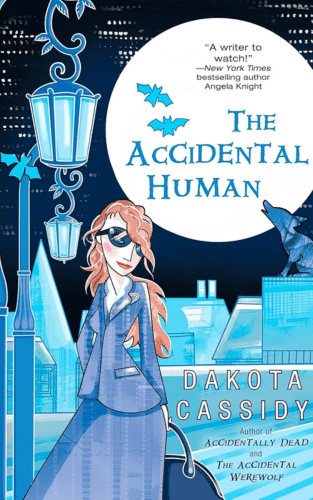
The Accidental Human by Dakota Cassidy
Wanda Schwartz is raking in the dough selling Bobbie-Sue Cosmetics-and she’s a pro at recruiting new saleswomen. So, she’s shocked when a man comes to one of her in-home parties-a very hot man. Heath Jefferson is sure to put some extra spin into a lot of women’s color wheels.
When Wanda is diagnosed with a terminal illness, it doesn’t have to be a death sentence. With a werewolf and a vampire for best friends, she has options that most ordinary people wouldn’t. As Wanda ponders what to do about her mortality, Heath reveals he has secrets, and one of them is that his former bloodlust has turned into an old-fashioned lust-for Wanda. And he’s already given up too much to lose the love of his lifetimes.
The Bite Breakdown:
Quick Verdict
This is the book where the series finally slows down enough to matter. After a rocky second installment, this one earns its place by centering vulnerability instead of chaos.
At a Glance
- Genre: Paranormal Romance
- Subgenre: Urban Fantasy Romance, Paranormal Fantasy
- Trope: Accidental Immortality
- Series: Accidentally Paranormal series book 3, The Accidentals book 3
- POV: Third Person
- Romance Focus: Established relationship facing mortality
- Tone: Wry, emotionally grounded, quietly serious beneath the humor
The Premise (No Spoilers)
The Accidental Human by Dakota Cassidy follows Wanda, who begins the story fully human and painfully aware that her time is limited. Her terminal illness shapes every choice she makes, even when she tries to downplay its impact on the people around her.
The paranormal element does not erase that reality. Instead, it complicates it. Wanda’s humanity remains central, especially as supernatural solutions tempt her with escape routes that come at emotional cost. The story resists turning her illness into spectacle, focusing instead on how fear, love, and stubborn independence coexist when the clock refuses to slow.
As Accidentally Paranormal series book 3 and The Accidentals book 3, this installment deepens the ensemble by grounding it in mortal stakes. The series steps away from pure hijinks and lets consequence carry more narrative weight than before.
What Worked
Wanda’s perspective anchors the book. Her awareness of her illness gives the story an undercurrent of urgency that sharpens both humor and tenderness. That balance feels intentional rather than accidental, which marks a clear improvement over the previous book.
I also appreciated how the narrative treats choice as the real conflict. Power and immortality exist as options, not inevitabilities, which keeps Wanda firmly in control of her arc even when her body fails her.
What Didn’t Work (or Might Not)
Some tonal shifts arrive abruptly. The book occasionally jumps from humor to gravity without enough transition, which may pull readers out of the moment.
Readers looking for high paranormal stakes may find the external plot quieter than expected. The emotional arc carries the weight, sometimes at the expense of action.
Romance and Relationship Dynamics
The romance rests on honesty rather than fantasy fixes. Wanda’s relationship faces strain not because of misunderstanding, but because love does not protect anyone from loss. The dynamic emphasizes support without erasure, allowing affection to exist alongside fear.
- Terminal illness
- Mortality themes
- Emotional grief and anticipatory loss
Who Should Read This
This book suits readers who value emotional realism within paranormal romance. It will especially resonate with those willing to trade nonstop antics for character driven vulnerability.
Final Verdict
This was the book that made continuing the series worthwhile for me. By centering Wanda’s humanity instead of escaping it, the story delivers its strongest emotional payoff so far.
Book Rating: 4 Stars
The emotional focus feels more controlled and purposeful than earlier installments.
Heroine Strength: 4 Crowns
Wanda asserts agency through choice, even when her options narrow.
Spice Rating: 3 Flames
Intimacy supports the emotional stakes without overwhelming the story.
Choosing What Survival Means
In The Accidental Human by Dakota Cassidy, Wanda’s struggle centers on control rather than fear. Those around her want to protect her, but protection quickly slides into decision making. The tension sharpens when their urgency clashes with Wanda’s need to define her own terms, especially as time narrows her options.
The possibility of escaping mortality introduces a fracture in Wanda’s relationship. What looks like salvation to one partner reads as erasure to the other, and neither position feels simple or clean. Love remains present, but it no longer guarantees alignment, forcing both characters to confront what support actually means.
Immortality loses its shine as the story unfolds. The narrative frames supernatural endurance as a trade rather than a gift, carrying losses that echo beyond the individual. By the end, survival no longer stands as the obvious goal, and the book challenges the series’ earlier assumptions about power as privilege.


Leave a Reply