
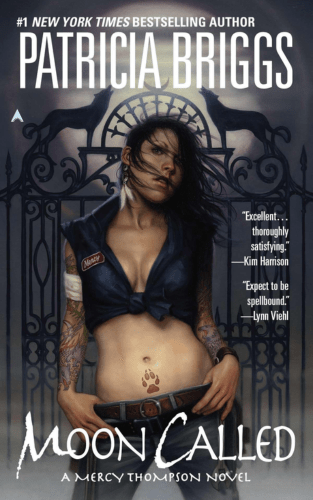
Moon Called by Patricia Briggs
“Mercy Thompson is a shapeshifter, and while she was raised by werewolves, she can never be one of them, especially after the pack ran her off for having a forbidden love affair. So she’s turned her talent for fixing cars into a business and now runs a one-woman mechanic shop in the Tri-Cities area of Washington State.
But Mercy’s two worlds are colliding. A half-starved teenage boy arrives at her shop looking for work, only to reveal that he’s a newly changed werewolf—on the run and desperately trying to control his animal instincts. Mercy asks her neighbor Adam Hauptman, the Alpha of the local werewolf pack, for assistance.
But Mercy’s act of kindness has unexpected consequences that leave her no choice but to seek help from those she once considered family—the werewolves who abandoned her…”
The Bite Breakdown:
Moon Called by Patricia Briggs
A grounded urban fantasy with sharp edges, slow trust, and a heroine who survives by knowing exactly who she is.
Quick Verdict
This book is for readers who want an urban fantasy heroine with real agency, emotional intelligence, and practical competence. If you are looking for high spice, rapid-fire action, or instant romantic payoff, this will feel restrained.
At a Glance
- Genre: Urban Fantasy
- Subgenre: Paranormal Fantasy; Urban Fantasy Thriller
- Trope: Hidden Power
- Series: Mercy Thompson series Book 1, Mercyverse Book 6
- POV: First person
- Romance Focus: Low
- Tone: Grounded, tense, character driven
The Premise (No Spoilers)
Moon Called introduces Mercy Thompson, a VW mechanic who lives quietly on the edge of a supernatural world that would prefer she stay invisible. Werewolves, vampires, and fae operate under uneasy truces, and Mercy survives among them by being useful, observant, and underestimated. When violence disrupts that balance, Mercy becomes involved not because she seeks power, but because she refuses to look away when something is wrong.
What this book promises is not spectacle. It promises perspective. The tension comes from proximity to power rather than possession of it, and the story asks what survival looks like when strength is measured in judgment, boundaries, and the ability to endure.
What Worked
The strongest element of Moon Called is Mercy herself. I trusted her almost immediately. She is competent without being flashy, compassionate without being reckless, and stubborn in a way that feels earned rather than performative. Mercy does not dominate situations. She navigates them. That distinction matters, especially in a genre that often equates power with worth.
Patricia Briggs excels at restraint. The worldbuilding is present but never overwhelming. Information arrives naturally through Mercy’s lived experience rather than exposition. The supernatural politics feel dangerous because Mercy understands how little protection she truly has, and that awareness informs every decision she makes. I appreciated that the story never pretends she can punch her way out of problems that are bigger than her.
The pacing is deliberate, but purposeful. Each interaction builds tension, especially in how Mercy moves through spaces controlled by others. Her relationships feel layered and cautious, shaped by history rather than convenience. Trust is slow. Safety is conditional. Those dynamics give the book emotional weight without requiring constant action.
Romance and Relationship Dynamics
Romance exists here as an undercurrent rather than a driving force. The connections are complicated, unfinished, and rooted in history rather than immediate chemistry. I found this refreshing. The story allows attraction and loyalty to develop without demanding resolution. Emotional safety, boundaries, and restraint matter more than sparks.
Readers who enjoy slow burn arcs that stretch across multiple books will find this satisfying. Readers who want romance to take center stage right away may feel impatient.
What Didn’t Work (or Might Not)
If you prefer fast-paced urban fantasy with frequent combat and dramatic twists, Moon Called may feel quiet at times. The story prioritizes setup, character positioning, and long-term stakes over immediate payoff. I did not find this a flaw, but it is a matter of reader taste.
The villains and conflicts are effective rather than complex. The focus remains on Mercy’s response to danger, not on deeply layered antagonists. Again, this serves the story’s goals, but some readers may want more narrative ambition in the opposition.
- Violence
- Threats and coercive behavior
- References to abuse and control
Who Should Read This
This book is a strong fit for readers who enjoy urban fantasy with:
• Capable but not overpowered heroines
• Emotional intelligence over brute force
• Slow build tension and long series arcs
• Romance that develops through trust rather than intensity
If you value character consistency and grounded stakes, this series opener does its job well.
Final Verdict
Moon Called does not try to dazzle. It earns loyalty instead. I walked away trusting Mercy Thompson and wanting to follow her forward, which is exactly what a first book in a long series should accomplish. The emotional aftertaste is quiet but persistent, and the foundations laid here pay dividends later.
Overall Rating: 4 Stars
This is a strong, grounded start to a long-running urban fantasy series that prioritizes character, restraint, and emotional intelligence over spectacle. It does not try to impress with excess. It earns trust instead.
Heroine Strength: 4 Crowns
Mercy Thompson is not the most powerful figure in the room, and that is exactly why she works. She survives through competence, empathy, stubborn resolve, and the refusal to surrender her autonomy. She makes choices, absorbs consequences, and never becomes a passenger in her own story.
Spice Level: 1 Flame
Very low heat. Romance exists mostly as tension, history, and undercurrent. Intimacy is off-page and easily skippable. This is an urban fantasy first, with romance developing slowly across the series rather than delivering immediate payoff.
This is urban fantasy with bite, not flash, and I will absolutely continue the series & reviews.
Great ready to lose yourself in this world!
Spoiler Summary and Implications
The central conflict ultimately reveals how fragile Mercy’s position truly is within the supernatural hierarchy. The murders and experimentation tied to rogue werewolf creation expose a world where power is routinely abused, and where beings like Mercy exist without institutional protection. The resolution does not magically fix this imbalance. Instead, it clarifies it.
Mercy survives not because she outmatches the antagonists, but because she understands limits. She chooses when to confront, when to retreat, and when to leverage relationships she would rather keep uncomplicated. The ending reinforces that intelligence and adaptability are her real strengths. There is no illusion that bravery alone is enough.
On the romantic front, the book deliberately avoids closure. Mercy’s connections remain unresolved, weighted by history and mutual restraint. The lack of a definitive romantic outcome is intentional. It signals that this series values emotional realism over neat resolutions, and that trust will be built slowly, if at all.
Perhaps most importantly, the fallout establishes Mercy’s reputation. She is no longer invisible. Her involvement forces powerful factions to acknowledge her existence, which quietly raises the stakes for every future book. Survival going forward will cost more, not less.





Leave a Reply