
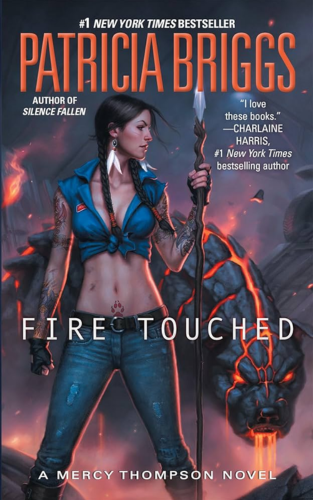
Fire Touched by Patricia Briggs
Tensions between the fae and humans are coming to a head. And when coyote shapeshifter Mercy and her Alpha werewolf mate, Adam, are called upon to stop a rampaging troll, they find themselves with something that could be used to make the fae back down and forestall out-and-out war: a human child stolen long ago by the fae.
Defying the most powerful werewolf in the country, the humans, and the fae, Mercy, Adam, and their pack choose to protect the boy no matter what the cost. But who will protect them from a boy who is fire touched?
The Bite Breakdown:
Quick Verdict
Fire Touched by Patricia Briggs is a tense, politically charged entry in the Mercy Thompson series that leans harder into consequences than comfort. I found it gripping and unsettling in the best way, especially for readers who like their urban fantasy to challenge both characters and power structures.
At a Glance
- Genre: Urban Fantasy
- Subgenre: Paranormal Fantasy; Urban Fantasy Thriller
- Trope: Claimed Territory
- Series: Mercy Thompson series book 9; Mercyverse book 26
- POV: First Person
- Romance Focus: Medium, established relationship under external pressure
- Tone: Dark, tense, politically charged
The Premise (No Spoilers)
In Fire Touched, the fragile balance between supernatural communities and the human world begins to fracture in dangerous ways. Mercy finds herself caught in escalating tensions that are no longer limited to local packs or personal vendettas. The stakes feel broader and more systemic, pushing the story beyond survival and into the realm of political consequence.
What stood out to me immediately was the sense of unease that runs through every interaction. This book asks uncomfortable questions about control, fear, and who gets to decide what safety looks like. Mercy is forced into situations where there are no clean solutions, only choices that carry weight no matter which direction she turns.
As a series installment, this novel functions as Mercy Thompson series book 9 and Mercyverse book 26. It builds directly on long running threads while clearly signaling that the larger universe is entering a more volatile phase. Longtime readers will recognize how much groundwork is being activated here, even as the story remains focused on Mercy’s personal perspective.
What Worked
The thematic ambition impressed me most. Patricia Briggs does not shy away from institutional fear or the ways power consolidates when people feel threatened. I appreciated how these ideas played out through character driven scenes rather than exposition. The tension feels earned because it grows out of relationships and history we already understand.
Mercy herself continues to shine as a grounded, stubborn, deeply human heroine. She does not suddenly gain new powers to solve bigger problems. Instead, she relies on empathy, observation, and a refusal to back down when autonomy is at stake. That consistency makes the darker turns in this book land harder.
What Didn’t Work (or Might Not)
This is not a fast, action first read. The pacing slows at times to explore negotiations, politics, and fallout. I enjoyed that depth, but readers who prefer tightly contained mysteries or constant momentum may find sections heavy.
The emotional tone is also sharper than in some earlier installments. Comfort takes a back seat to realism, and not every conflict resolves in a satisfying way. For me, that honesty worked. Still, readers looking for reassurance or lighter stakes may struggle with the sustained tension.
Romance and Relationship Dynamics
The romance here operates under stress rather than anticipation. This is an established partnership tested by external pressures and moral disagreement. I liked how the relationship emphasized trust and communication instead of dramatic misunderstandings. The intimacy is restrained, and the emotional core comes from standing together when the world turns hostile.
- Violence and threat of violence
- Themes of control and ownership
- Institutional fear and discrimination
Who Should Read This
This book is ideal for readers invested in the Mercyverse who enjoy long arc storytelling and moral complexity. If you like urban fantasy that explores power, politics, and personal cost without softening the edges, this one will likely work for you. If you want a lighter, more episodic entry, this may feel intense.
Final Verdict
Fire Touched by Patricia Briggs marks a turning point where the Mercyverse starts asking harder questions about coexistence and authority. I finished this book uneasy but engaged, which feels intentional. It deepens the series rather than simply extending it, and it left me eager to see how these fractures continue to unfold.
Overall Rating: 4 Stars
This book delivers a strong, unsettling experience that prioritizes consequence and thematic depth over easy resolution.
Heroine Strength Score: 4 Crowns
This book delivers a strong, unsettling experience that prioritizes consequence and thematic depth over easy resolution.
Spice Level: 2 Flames
Low to medium heat with mostly off page intimacy that can be skipped without losing the plot.
A Claimed Territory and a Shift in Power
This section looks at what Fire Touched by Patricia Briggs actually changes in the Mercyverse, without reframing events as broader government domination than the text supports. The turning point comes when the fae deliberately unleash a dangerous monster as a demonstration of their power. Their goal is not chaos for its own sake, but leverage. They want proof that the supernatural world cannot be ignored or managed quietly anymore.
When Mercy and the pack step in to defend their home city, the outcome reshapes local authority in a very specific way. Mercy formally claims the city as pack territory, declaring protection for everyone within it against supernatural harm. This is not a hostile takeover, but a line drawn in defense. By doing so, the pack becomes responsible for keeping the peace, not ruling through fear.
The fae then use this moment to push for negotiation with the human government. Rather than the government attempting containment, it is clear they are deeply afraid of the fae and need an intermediary they can tolerate. The werewolves fill that role. By mutual agreement among all supernatural factions in town, the pack eventually becomes the de facto leadership for the territory. The shift is local, intentional, and cooperative, and it sets a precedent that will matter far more later than any single confrontation in this book.






Leave a Reply