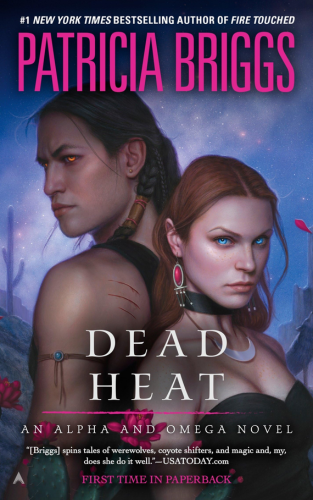
Dead Heat by Patricia Briggs
For once, mated werewolves Charles Cornick and Anna Lantham are not traveling because of Charles’s role as his father’s enforcer. This time, their trip to Arizona is purely personal. Or at least their visit starts out that way…
Charles and Anna soon discover that a dangerous fae being is on the loose, replacing human children with simulacrums. The fae have started a cold war with humanity that’s about to heat up—and Charles and Anna are in the crossfire.
The Bite Breakdown:
Quick Verdict
Dead Heat by Patricia Briggs is a grounded, emotionally charged urban fantasy that leans harder into family, loyalty, and consequence than spectacle. I found it especially rewarding for the way it deepens Charles as a character, adding quiet heartbreak to an already tense story.
At a Glance
- Genre: Urban Fantasy
- Subgenre: Paranormal Fantasy; Urban Fantasy Thriller
- Trope: Consequences of Immortality
- Series: Alpha and Omega series book 4; Mercyverse book 21
- POV: Dual Third Person
- Romance Focus: Medium, established relationship
- Tone: Dark, tense, emotionally reflective, character driven
The Premise (No Spoilers)
While visiting an old friend of Charles, Dead Heat draws Anna and Charles into a conflict that is a direct consequence of the fae letting lose their monsters after the events of Fair Game. The danger is immediate, physical, and external, forcing the werewolves to respond not just as individuals, but as protectors standing between humanity and something far worse.
One of the elements I enjoyed most was the deeper look into Charles’ past, which unfolds alongside the present threat. The story explores a rare period in his long life when he formed a genuine, close friendship outside his usual isolation. Watching that bond evolve, and eventually fade as his friend aged while Charles did not, adds a quiet, lingering sadness that grounds the action in emotional reality.
Within the larger universe, this novel strengthens the Alpha and Omega arc while continuing to expand the Mercyverse. As Alpha and Omega series book 4 and Mercyverse book 21, it builds directly on prior events while using character history and consequence to deepen the ongoing narrative.
What Didn’t Work (or Might Not)
The pacing is still measured, even with an external threat driving the plot. While the danger is real and immediate, Patricia Briggs allows scenes to breathe, particularly when emotional or relational moments take center stage. Readers who prefer relentless action without pause may find this approach slower than expected.
Additionally, this book assumes familiarity with the fallout from Fair Game. While the stakes are clear, new or returning readers who skipped the previous installment may feel slightly unmoored at first before the full context settles into place.
- Violence
- Fae creatures attacking children
- Loss tied to immortality
- High risk situations involving civilians
Final Verdict
Dead Heat by Patricia Briggs balances external danger with emotional depth in a way that feels distinctly Mercyverse. The fae driven threat gives the story real urgency, while the exploration of Charles’ past adds a reflective weight that elevates the book beyond action alone. This installment reminded me how well the series handles consequence, both magical and personal.
Overall Rating: 4 Stars
This book delivers a strong blend of action and character work, rewarding readers who are invested in both the world and its people.
Heroine Strength: 5 Crowns
Anna continues to shape outcomes through perception, resolve, and calm authority, proving once again that strength does not need to be loud to be decisive.
Spice Level: 1 Flame
Very low heat with an established couple. Intimacy is minimal and easily skipped without affecting the plot or emotional continuity.
The Cost of What Was Unleashed
In Dead Heat by Patricia Briggs, the danger Anna and Charles face is not random or isolated. The threat comes directly from the fae sending their their monsters out into the world after the events of Fair Game, and that act of terrorism spills into human territory with lethal consequences. This is not a mystery to unravel so much as a punishment problem that is already failing by the time the story begins.
Charles’ role as Bran’s enforcer becomes especially heavy here, because solving the problem requires violence that cannot be softened or redirected. The monster cannot be reasoned with, and mercy is not an option. That reality reinforces one of the book’s central themes: some consequences cannot be undone, only endured and survived.
The emotional weight lands hardest through Charles’ memories of his past friendship. Seeing how deeply he once connected to a human friend, only to watch that bond fade as time moved on without him, reframes his present choices. It makes clear why his commitment to Anna matters so much. She is not temporary. She is not passing through his life. In a world where immortality strips things away piece by piece, that permanence becomes its own quiet victory.



Leave a Reply