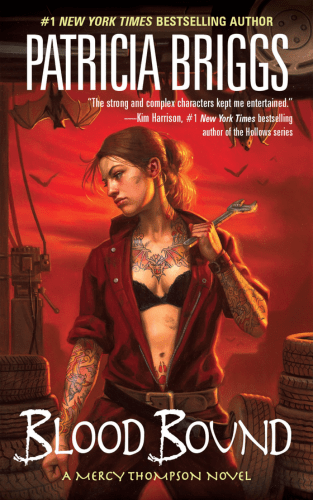
Blood Bound by Patricia Briggs
Mercy has friends in low places—and in dark ones. And now she owes one of them a favor. Since she can shapeshift at will, she agrees to act as some extra muscle when her vampire friend Stefan goes to deliver a message to another of his kind. But this new vampire is hardly ordinary—and neither is the demon inside of him.
When the undead and the werewolves sent to find him don’t return, the local vampire queen turns to Mercy for help. A coyote is no match for a demon, but Mercy is determined to get her friends back—including the two werewolves circling around her heart.
The Bite Breakdown:
Quick Verdict
A darker, sharper second entry that expands the Mercyverse while testing Mercy Thompson’s limits in ways that feel genuinely dangerous and personal. This is where the series proves it is willing to get its hands dirty.
At a Glance
- Genre: Urban Fantasy
- Subgenre: Paranormal Fantasy; Urban Fantasy Thriller
- Trope: Power Imbalance
- Series: Mercy Thompson Series Book 2; Mercyverse Book 11
- POV: First Person
- Romance Focus: Low
- Tone: Dark, tense, character driven
The Premise (No Spoilers)
In Blood Bound by Patricia Briggs, Mercy Thompson is pulled into vampire politics far deeper and more dangerous than anything she faced before. What begins as a favor quickly spirals into a situation where power, obligation, and survival collide, forcing Mercy to navigate ancient rules, shifting alliances, and threats she cannot simply outfight.
What I appreciated most about this setup is how it reframes Mercy’s role in the supernatural ecosystem. She is no longer operating on the edges of power, fixing problems that mostly belong to others. In this story, she becomes a known quantity, someone whose choices ripple outward whether she wants that responsibility or not. The premise promises escalation rather than repetition, making it clear that the Mercy Thompson series is not content to reset stakes between books. Instead, it steadily tightens the net around Mercy, asking what survival looks like when opting out is no longer an option.
As the second book in the Mercy Thompson series and the eleventh story in the wider Mercyverse, this installment broadens the scope of the world while sharpening the consequences of Mercy’s choices.
What Worked
What stood out most for me was how confidently this book expands the supernatural hierarchy without losing Mercy’s grounded perspective. Vampires are not romanticized here. They are terrifying, manipulative, and ancient in ways that feel earned rather than theatrical. The rules governing them add tension to every interaction, and I appreciated how clearly Briggs communicates the stakes without over explaining.
Mercy herself continues to shine as a heroine who survives through intelligence, stubborn resolve, and an unshakable sense of self. She does not suddenly gain power to match her enemies. Instead, she adapts, negotiates, and endures. That restraint makes the danger feel real, and it reinforces why Mercy works so well as a long term protagonist.
The pacing also improves from book one. The story tightens quickly and rarely lets up, balancing investigation, confrontation, and fallout in a way that kept me engaged without feeling rushed.
What Didn’t Work (or Might Not)
Readers looking for fast moving romance may find this installment restrained. Emotional tension exists, but it simmers in the background rather than driving the plot. For me, this worked, but romance forward readers may feel impatient.
There is also a noticeable tonal shift toward darker themes. While I found that effective, readers expecting a lighter urban fantasy may be surprised by how bleak some moments become. This is not a cozy entry in the series, and it does not try to be.
Romance and Relationship Dynamics
Romance here is quiet, complicated, and deeply entangled with trust and power rather than passion. Mercy’s relationships are shaped by respect, caution, and emotional history more than overt desire. I liked how the story allows attraction and loyalty to exist without demanding immediate resolution. The slow burn continues, and it feels intentional rather than delayed for drama’s sake.
- Violence
- Coercion and control themes
- Threats of bodily harm
- Dark supernatural politics
Who Should Read This
This book is a strong fit for readers who enjoy urban fantasy with real stakes, morally gray power structures, and heroines who rely on competence rather than dominance. If you value tension, consequence, and long game character development, this one delivers. Readers seeking light banter or romance led plots may want to adjust expectations.
Final Verdict
Blood Bound deepened my trust in the Mercy Thompson series. It proves that Patricia Briggs is willing to challenge her heroine, complicate her world, and let consequences linger. The emotional aftertaste is tense and unsettling in the best way, and it solidified my commitment to continuing the series.
Overall Rating: 4 Stars
A darker, more confident continuation that expands the world while keeping Mercy firmly in control of her own story.
Heroine Strength: 4 Crowns
Mercy Thompson remains defined by agency, resilience, and the refusal to surrender her autonomy even when outmatched.
Spice Level: 1 Flame
Very low heat with romance expressed through tension and subtext rather than on page intimacy. Easily skippable for readers focused on plot.
Trapped Between Monsters
Blood Bound by Patricia Briggs marks the moment where the Mercyverse decisively pulls Mercy into long game supernatural politics rather than one off crises. The central conflict forces Mercy into direct proximity with vampire power structures that do not bend, negotiate, or forget. Her role in resolving the situation is not about defeating the threat outright, but about surviving it without losing herself, which reinforces the series’ commitment to consequences over spectacle.
The emotional weight of this book lands in what Mercy is required to endure rather than what she is allowed to change. She is controlled, used as leverage, and placed in situations where her consent barely registers, yet the story never frames this as character building through suffering. Instead, it establishes a baseline truth for the series: Mercy will survive, but survival will often leave marks. This experience reshapes how she approaches power going forward and permanently alters how others in the supernatural community perceive her.
On the relationship front, this installment subtly recalibrates the romantic landscape. Trust deepens through action rather than words, and loyalty is demonstrated quietly but decisively. There is no grand romantic payoff, but there is a clear emotional shift that pays dividends later in the series. By the end, Blood Bound closes the door on the illusion that Mercy can remain untouched by the darker currents of her world, firmly committing the series to higher stakes and longer consequences from this point on.






Leave a Reply