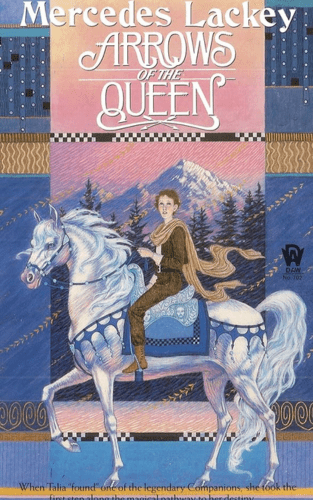
Arrows of the Queen by Mercedes Lackey
Chosen by the Companion Rolan, a mystical horse-like being with powers beyond imagining, Talia, once a runaway, has now become a trainee Herald, destined to become one of the Queen’s own elite guard. For Talia has certain awakening talents of the mind that only a Companion like Rolan can truly sense.
But as Talia struggles to master her unique abilities, time is running out. For conspiracy is brewing in Valdemar, a deadly treason that could destroy Queen and kingdom. Opposed by unknown enemies capable of both diabolical magic and treacherous assassination, the Queen must turn to Talia and the Heralds for aid in protecting the realm and insuring the future of the Queen’s heir, a child already in danger of becoming bespelled by the Queen’s own foes.
The Bite Breakdown:
Quick Verdict
Arrows of the Queen by Mercedes Lackey remains a formative, quietly powerful fantasy that centers empathy, choice, and belonging long before those ideas felt common. Its influence lingers less through spectacle and more through how completely it invites readers to believe in gentler kinds of strength.
At a Glance
- Genre: Fantasy
- Subgenre: Classic Quest Fantasy, Heroic Fantasy
- Trope: Chosen One
- Series: Heralds of Valdemar series book 1, Valdemar book 28
- POV: Third Person
- Romance Focus: Secondary and understated
- Tone: Hopeful, earnest, emotionally grounded
The Premise (No Spoilers)
Talia grows up isolated, fearful, and convinced that survival means staying small. Her escape from that life begins with a desperate choice and an encounter that reshapes everything she believes about herself and the world. Valdemar opens as a place of safety, yet the story never pretends that safety removes struggle or fear.
Training as a Herald forces Talia to confront responsibility, loss, and the weight of empathy in a broken world. Her gifts do not protect her from pain, and the narrative treats emotional cost as seriously as external danger. Growth arrives unevenly, shaped by mistakes and quiet perseverance rather than triumph.
As the opening of the Heralds of Valdemar series book 1 and Valdemar book 28, this novel lays emotional and thematic groundwork that echoes across the wider universe. Later books deepen the politics and scale, yet this beginning remains the emotional compass of the setting.
What Worked
The emotional core carries the story with steady confidence. Talia’s sensitivity never reads as weakness, because the narrative insists that compassion demands courage. Mercedes Lackey allows trauma, healing, and resilience to exist together without forcing easy resolutions.
The worldbuilding favors clarity over excess. Valdemar feels lived in, guided by values rather than intricate systems, which makes the stakes feel personal instead of abstract. Companions, mentors, and bonds form a found family that feels earned through shared vulnerability.
What Didn’t Work (or Might Not)
Readers seeking fast pacing or constant action may find the structure restrained. Much of the tension unfolds internally, and external conflicts build slowly. The prose reflects its era, which may feel straightforward to those accustomed to more modern stylistic density.
Some emotional beats resolve gently rather than dramatically. That restraint serves the themes, but it may frustrate readers who prefer sharper turns or heightened conflict.
Romance and Relationship Dynamics
Romance remains peripheral and intentionally soft. Emotional trust, loyalty, and care matter more than attraction or passion. Relationships function primarily as support systems that reinforce growth rather than dominate the narrative.
- Child abuse (off page, referenced)
- Emotional trauma
- Bullying and social cruelty
Who Should Read This
This book suits readers drawn to character driven fantasy rooted in kindness, growth, and moral clarity. It works especially well for those who value emotional resonance over complexity and who appreciate found family stories that take pain seriously without becoming bleak.
Final Verdict
This novel shaped my reading life in ways few books ever have. As one of the first fantasy stories I encountered, it opened a door to worlds where empathy mattered as much as power, and that perspective never left me.
Book Rating: 5 Stars
The story earns its place through emotional honesty and lasting influence rather than scale or spectacle.
Heroine Strength: 5 Crowns
Talia’s strength lies in endurance, compassion, and the courage to remain open in a harsh world.
Spice Rating: 1 Flame
Romance stays minimal and gentle, with focus placed firmly on growth and belonging.
The Cost of Power and Trust
In Arrows of the Queen by Mercedes Lackey, Talia’s empathic Gifts shape every success and every failure. Her ability to feel others so deeply leaves her exposed during Herald training, where emotional overload becomes as dangerous as any physical threat. Rather than mastering her power through control, she learns endurance, boundaries, and the painful necessity of withdrawal, which reframes strength as survival rather than dominance.
Political danger presses in as Valdemar’s stability proves fragile. What begins as personal training shifts into preparation for real conflict, and Talia’s role expands before she feels ready. Court intrigue and external threats force her to confront how quickly innocence becomes liability, especially for someone whose nature leans toward trust and openness.
Betrayal cuts deepest because it comes from within the structures meant to protect her. When authority figures fail, Talia must reconcile her belief in Valdemar’s ideals with the reality that good systems still allow harm. That reckoning hardens her without breaking her, marking the moment where belonging stops being unconditional and becomes something she must choose with clear eyes.
(NOTE: This is the first novel/series published in the Valdemar Universe, though the world itself does not require strict reading order. Each series stands on its own, allowing readers to enter at many points without confusion. That said, because later written series explore earlier periods in Valdemar’s history, a chronological read offers a fuller sense of how the world, its values, and its power structures evolve over time.)



Leave a Reply