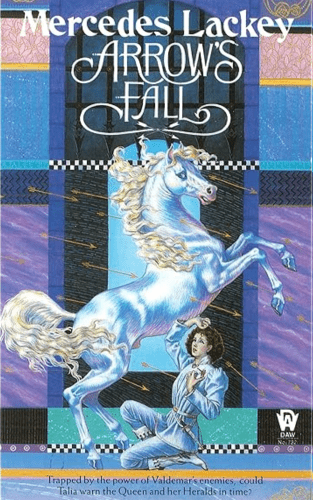
Arrow’s Fall by Mercedes Lackey
With Elspeth, the heir to the throne of Valdemar, come of marriageable age, Talia, the Queen’s Own Herald returns to court to find Queen and heir beset by diplomatic intrigue as various forces vie for control of Elspeth’s future.
But just as Talia is about to uncover the traitor behind all these intrigues, she is sent off on a mission to the neighboring kingdom, chosen by the Queen to investigate the worth of a marriage proposal from Prince Ancar. And, to her horror, Talia soon discovers there is far more going on at Prince Ancar’s court than just preparation for a hoped-for royal wedding. For a different magic than that of the Heralds is loose in Ancar’s realm—an evil and ancient sorcery that may destroy all of Valdemar unless Talia can send warning to her Queen in time!
The Bite Breakdown:
Quick Verdict
Arrow’s Fall by Mercedes Lackey is the emotional breaking point of the Heralds arc, where idealism finally collides with exhaustion, grief, and responsibility. This book hurt in a quiet, earned way, and I respect it deeply for refusing easy triumph.
At a Glance
- Genre: Fantasy
- Subgenre: Epic Fantasy, Heroic Fantasy
- Trope: Reluctant Heroine
- Series: Heralds of Valdemar Book 3, Valdemar Book 30
- POV: Dual Third Person with Occasional Alternate POVs
- Romance Focus: Secondary and understated, shaped by duty and distance
- Tone: Somber, character-driven, emotionally heavy
The Premise (No Spoilers)
Talia’s role as a Herald no longer feels like an honor she grows into, but a weight that reshapes every part of her life. Responsibilities compound faster than her ability to recover, and each new demand exposes how little space she has left for herself. Rather than escalating through spectacle, the story narrows inward, focusing on how constant service erodes even the most sincere sense of purpose.
What struck me most is how the narrative treats exhaustion as cumulative rather than dramatic. Talia does not fail because she lacks courage or skill, but because the system around her never pauses long enough to let her heal. The emotional pressure builds through expectations, silence, and the belief that endurance equals virtue, which made her struggle feel painfully real.
As Heralds of Valdemar series book 3 and Valdemar book 30, this installment marks a tonal shift for the larger universe. Earlier foundations of idealism and destiny give way to consequence, setting the emotional stakes that later Valdemar stories continue to explore with increasing honesty.
What Worked
The emotional realism carries this book. Lackey allows trauma to linger without aestheticizing it, and Talia’s reactions feel grounded rather than performative. I appreciated how the story refuses to frame suffering as character building shorthand, instead showing how unaddressed pain narrows a person’s world.
Worldbuilding also benefits from restraint here. Valdemar feels less mythic and more institutional, which strengthens the book’s thematic core. Power structures, even benevolent ones, still extract a cost, and the story never looks away from that truth.
What Didn’t Work (or Might Not)
Readers expecting momentum or external plot escalation may find this entry slower and heavier than previous books. Much of the conflict unfolds internally, and patience is required to sit with discomfort rather than wait for catharsis.
Some supporting characters remain distant by design, which reinforces Talia’s isolation but may feel emotionally withholding to readers who crave stronger ensemble presence.
Romance and Relationship Dynamics
Romantic elements exist quietly, shaped by duty and emotional imbalance rather than longing or chemistry. Connection here feels conditional and fragile, reinforcing the book’s larger message that love does not automatically compensate for systemic neglect.
- Emotional burnout
- Trauma and psychological distress
- Institutional pressure and lack of support
Who Should Read This
This book suits readers who value character psychology over action and who appreciate fantasy that interrogates service, sacrifice, and emotional labor. Anyone seeking comfort fantasy or triumphant escapism should approach with caution.
Final Verdict
This is not an easy book, but it is an honest one, and its restraint gives it lasting weight. Arrow’s Fall trusts the reader to sit with unresolved pain, and that trust makes it quietly powerful.
Book Rating: 4 Stars
The emotional depth and thematic clarity outweigh the deliberate pacing and heavy tone.
Heroine Strength: 4 Crowns
Talia’s strength lies in endurance and moral integrity, even when the cost becomes unsustainable.
Spice Rating: 1 Flame
Romance remains minimal and subdued, serving character context rather than reader gratification.
When Duty Becomes Survival
In Arrow’s Fall by Mercedes Lackey, the line between self sacrifice and erasure finally breaks when Talia is captured and tortured, not as a test of courage, but as the inevitable outcome of relentless expectation. Her suffering does not feel symbolic or abstract, because the story roots it in exhaustion, isolation, and a system that trained her to endure without ever teaching her how to stop.
Dirk’s rescue of Talia through a desperate act of Fetching reads as heroic on the surface, yet the book refuses to let that framing stand alone. His actions come from his own unraveling, driven by the lifebond he shares with Talia and the damage caused by both of them running from its reality. Rather than restoring order, the rescue exposes how deeply both Heralds have fractured under the weight of duty.
What lingers is not triumph, but consequence. Talia returns home alive, yet fundamentally changed, carrying trauma that service cannot justify away, and injuries that will take months to heal. The novel makes it painfully clear that survival does not equal healing, and that devotion without limits ultimately destroys the very people it claims to honor.
(NOTE: This is the second novel/first series published in the Valdemar Universe, though the world itself does not require strict reading order. Each series stands on its own, allowing readers to enter at many points without confusion. That said, because later written series explore earlier periods in Valdemar’s history, a chronological read offers a fuller sense of how the world, its values, and its power structures evolve over time.)


Leave a Reply