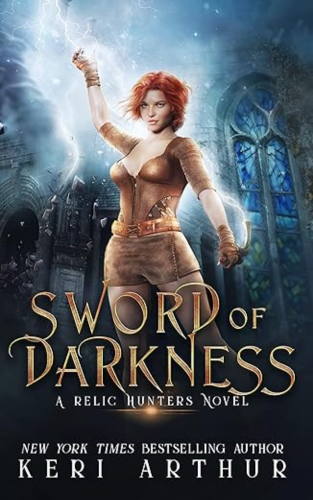
Sword of Darkness by Keri Arthur
The race to claim Agrona’s Claws continues…
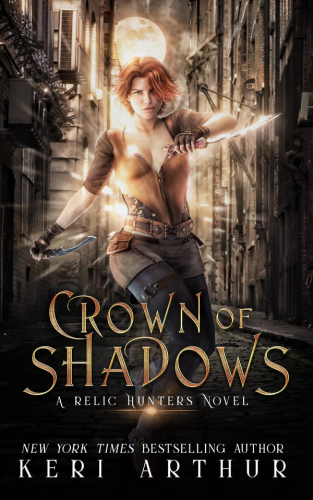
Agrona’s claws—three godly artifacts that, when used together, have the power to either extend darkness or utterly banish it—were deliberately hidden eons ago so that no man or woman would ever again wield them. But nothing stays hidden forever, and the Crown of Shadows was recently unearthed and stolen, despite Bethany Aodhán’s best efforts to stop it.
Now Beth and her brother Lugh must seek out the Sword of Darkness before those intent on destruction can reunite two of the three Claws and unleash chaos.
But even the help of a cranky goddess and two sexy elves might not be enough to save the day… or the world itself.
Because the forces of darkness are gathering momentum, and its origin lies closer to home than any of them guessed.
The Bite Breakdown:
Quick Verdict
Sword of Darkness by Keri Arthur is a confident second instalment that earns its place in the series by expanding Beth’s powers without reducing her to them. Arthur keeps the pace urgent and the stakes personal, and the result is urban fantasy that moves like a thriller without forgetting to be fun. The romance thread is warm and deliberate rather than rushed, and the mystery holds together well enough to carry the read. If Book 1 introduced the world, this one settles into it.
At a Glance
- Genre: Urban Fantasy
- Subgenre: Fae / Paranormal Investigation
- Trope: Slow burn, competent heroine, power awakening, ex still in the picture
- Series: Relic Hunters, Book 2
- POV: First person, single narrator (Beth Aodhán)
- Romance Focus: Slow burn between Beth and dark elf Cynwrig; secondary thread with Lugh and Darby
- Tone: Wry, warm, action-forward with bursts of dry humour
The Premise (No Spoilers)
Beth Aodhán is a tall pixie running a family tavern in Deva, a fae city layered over Chester, while her brother Lugh hunts relics for the National Fae Museum. The two of them are still processing the discovery of their mother’s murder when this book picks up, and the grief sits under everything, quiet but present. They’re racing a shadowy faction called the Looisearch to secure the three godly relics known as Agrona’s Claws before those objects fall into the wrong hands and rewrite the conditions of the world itself. Book 2 targets the second Claw, the Sword of Darkness, and the hunt pulls Beth across Deva, into Liverpool, over to Ireland, and down to the coast of Wales.
What distinguishes this series from generic fae-world urban fantasy is Arthur’s investment in making Beth’s growing power feel earned rather than convenient. Beth inherits storm magic from a god she’s never met and can commune with wood and stone through touch. Neither ability arrives neat and ready to use. She misjudges things, burns through her reserves, and occasionally makes a mess of a situation she thought she had under control. For a reader who has grown tired of heroines whose power curves always bend in their favor, that texture registers.
As the second book in the trilogy, this one functions well as a standalone read but rewards those who started with Crown of Shadows. The first book’s events cast a long shadow here in the best sense, feeding consequence into every decision Beth and Lugh make.
What Worked
Arthur’s greatest strength in this instalment is consequence management. Beth pays a real price for pushing her abilities too far, and the cost shows up physically, emotionally, and in terms of the relationships around her. When she overextends her mind control, it doesn’t simply drain her and vanish as a plot point. The fallout shapes the back third of the novel and leads to one of the more painful personal scenes in the book. That cause-and-effect discipline keeps the magic from feeling like a narrative cheat code, which is a genuine craft achievement in a genre where power often exists to solve problems on demand.
The sibling dynamic between Beth and Lugh is one of the most convincing elements in the series. Their rapport reads as lived-in rather than performed. They bicker with the ease of people who grew up sharing walls, support each other without announcement, and carry identical grief over their mother in different ways. Lugh functions as a capable adult in his own right rather than a device for Beth to bounce exposition off, and that distinction matters for the book’s pacing. When scenes require two competent people working a problem together, Arthur delivers both.
Beth’s voice carries the read. She is self-aware enough to be interesting and pragmatic enough to avoid the cycles of self-doubt that can stall a first-person heroine. Her dry observations break tension at exactly the right moments, and her reluctance to romanticize her own abilities keeps her credible even as those abilities grow. The relationship with Cynwrig builds with real patience. Neither character tips toward the other too quickly, and the heat between them stays warm without overtaking the plot.
What Didn’t Work (or Might Not)
The Looisearch remain somewhat underdeveloped as antagonists through most of the book. Their goal is clear enough, and the threat they represent is serious, but as a faction they operate at a remove. Readers who want a villain with genuine menace and page presence may feel the absence. The proxies and intermediaries Arthur uses to deliver threat work well on a scene-by-scene basis, but they’re not quite a substitute for a human-scale face on the opposition.
The middle section carries a fair amount of travel logistics and investigative legwork. For readers who enjoy the procedural texture of relic hunting, this will read as satisfying. For readers who prefer a tighter throughline, a few of those scenes may feel like they hold the book in place rather than move it forward. Nothing is badly paced, but the book does take slightly longer to build toward its second half than the first book’s momentum might lead readers to expect.
The Annwfyn, flesh-eating shadow folk who exist alongside the main world, carry significant implied threat without ever quite delivering a scene that cashes in on it. Their role is more atmospheric than active. That restraint may be intentional world-building held for a later book, but as a reader arriving fresh to this threat, it can feel like a promise that doesn’t quite pay off here.
Romance and Relationship Dynamics
The relationship between Beth and Cynwrig is a slow burn in the truest sense: it earns its heat by refusing to hurry. Cynwrig is a dark elf with a complicated family situation and a very controlled surface, and Arthur uses that surface intelligently. Beth is attracted to him, aware of her own track record with elves, and unwilling to pretend she isn’t thinking clearly when she probably is. That self-awareness sets the dynamic apart from the standard “she knows it’s a bad idea but can’t help herself” formation. She can help herself. She chooses to proceed at a considered pace, and that choice belongs to her.
The tension between them accumulates through proximity and small moments rather than manufactured conflict. Cynwrig’s willingness to step into danger beside Beth rather than ahead of her registers as respect rather than performance, and that matters for how the romance reads. There is real warmth in the scenes where they simply share space, and the restraint Arthur exercises keeps the payoff feeling genuinely anticipated. By the end of the book, the romance has progressed in a way that feels proportionate rather than artificially stalled.
The secondary romantic thread between Lugh and Darby runs quieter and funnier, and serves as a useful contrast. Darby is direct and unsentimental about what she wants, Lugh is allergic to admitting anything, and the scenes between them carry an easy pleasure.
- Grief and loss, including parental death and its ongoing emotional aftermath
- Violence including fights, deaths, and explosions
- Mind control used on an unwilling subject, with ethical complexity addressed in the text
- Amputation referenced in the resolution
- Mild spice, kissing and implied intimacy, nothing explicit
- Alcohol consumption as a background social element
Who Should Read This
This book suits readers who enjoy urban fantasy that trusts its heroine to be competent without making her infallible. If you want a detective-style relic hunt layered over fae world-building, a romance that respects your patience, and a protagonist whose internal voice is wry rather than mopey, this is well-suited to you. It also works for readers who love a sibling dynamic done right, or who prefer their magic systems to come with real costs. Skip it if you need a villain you can actually fear, or if you find mid-series investigative pacing frustrating when the action isn’t quite constant.
Final Verdict
Sword of Darkness by Keri Arthur is a solid, warm, and well-constructed second book that doesn’t stumble in the ways second books so often do. Arthur keeps Beth moving forward, keeps the stakes genuinely consequential, and keeps the romance building at a pace that makes it worth following. The world continues to expand without becoming cluttered, and the emotional threads around family, grief, and loyalty give the relic hunt more weight than the plot alone could carry. It won’t convert readers who aren’t already interested in the genre, but for those who are, it delivers exactly what a second instalment should: more of what worked, developed with more confidence.
Book Rating: 4 Stars
A well-executed second book that expands the world and deepens the stakes without losing the warmth and momentum that made Book 1 work.
Heroine Strength: 4 Crowns
Beth operates with genuine agency throughout, makes consequential decisions that cost her, and grows in power without losing her grounded, self-aware perspective.
Spice Rating: 2 Flames
The romance builds with real heat but stays restrained, with tension and warmth rather than explicit content.
The Cousin Who Knew the Price and Paid It Anyway
Vincentia’s betrayal lands hard precisely because Beth saw it coming and couldn’t stop it. The revelation that her cousin physically stole the Crown of Shadows and delivered it to the Looisearch reframes the events of Book 1 as an inside job enabled by family. Vincentia operated with full knowledge of what the Looisearch intended, witnessed the murder of Raen during the handoff, and proceeded anyway, apparently calculating that her employers’ gratitude would outlast her usefulness. What makes the betrayal cut deeper than simple greed is the detail that Aunt Riayn knew or suspected and chose deliberate inaction, making Beth’s grief about the Aodhán line itself, not just one bad actor within it.
The Stone That Remembers
Arthur handles the standing stone sequence with more restraint than the surrounding action chapters, and that quieter register makes it one of the book’s most distinctive passages. Beth’s working theory, that the stone at Nercwys Forest is a monument tied to the goddess Eithne whose Eye she now carries, proves correct, and the contact she makes through it functions less like a power-up and more like a conversation with something very old and only partially interested in helping. The vision she draws from it, a cave, a ruined chapel, golden bats in darkness, gives the team the final locational thread they need to find Draig Y Môr. More quietly, it establishes that Beth’s relationship with the Eye is not simply about accessing visions but about being recognized and responded to by forces that predate the current world order.
When the Punishment Fits the Family
The final chapter’s emotional weight comes not from the sword retrieval but from the drive to Galway. Delivering the pixie council’s ruling against Aunt Riayn is the consequence of a book’s worth of accumulated betrayal, and Arthur earns the scene’s difficulty by never letting it feel clean. Beth and Lugh arrive as kin required by law to act as instruments of a judgment they didn’t choose, and Riayn’s response, cutting off her sister’s children the moment the sentence lands, closes a door that had already been closing for a hundred pages. Vincentia loses her hand and two fingers in the island confrontation and will eventually join her mother in the land-bound sentence. That Beth cannot fully unpack the mind control she placed on Vincentia, meaning the damage she did runs deeper than she intended, sits alongside the council’s punishment as proof that in this series, choices accrue rather than resolve.


Leave a Reply