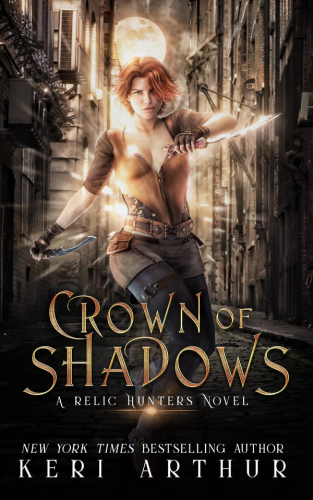
Crown of Shadows by Keri Arthur
Never mess with the relics of the old gods… or the pixies who once guarded them.
After her mom’s disappearance six months ago, Bethany Aodhán has been running their tavern in old Deva—something her family had been doing ever since a light-fingered pixie lost them the job of guarding the treasures of the old gods eons ago.
Then her brother, Lugh, is attacked, his best friend murdered, and the tavern firebombed. A confrontation with a former lover leads to the discovery of another murder and a missing jewel from a godly relic, and Beth learns that the Éadrom Hoard—one of three godly hoards now guarded by the elves—has been stolen.
But this is no ordinary theft. Darker forces are at work, and they’re not only seeking the means to resurrect a god of destruction but the power to forever banish daylight. That power lay with Agrona’s Claws—three godly artifacts that, when used together, give the user full control over night itself.
With the webs of suspicion drawing ever tighter around them, Beth & Lugh—with the help of two sexy elves and a cantankerous old goddess who knows far more than she admits—race to find the missing artifacts before those intent on unleashing chaos.
It’s a race they must win, because it’s not just their lives on the line, but the fate of modern-day England.
The Bite Breakdown:
Quick Verdict
Crown of Shadows by Keri Arthur opens a series with unusual confidence, delivering a heroine who operates with genuine competence rather than plot-assigned exceptionalism, set inside a fae world that feels lived-in rather than constructed for wonder. Arthur grounds her mythology in a modern English city without flattening it, letting the old powers feel genuinely old while still parking them next to taxi ranks and heritage council bureaucracy. Pacing is aggressive, the mystery layered, and Beth herself carries the novel with the kind of dry self-awareness that makes first-person urban fantasy work when it actually works. Readers who have grown tired of heroines who spend half the book discovering they are special will find this a satisfying corrective.
At a Glance
- Genre: Urban Fantasy
- Subgenre: Fae / Paranormal Investigation
- Trope: Fated heroine awakening to power; found family; dangerous romance
- Series: Relic Hunters, Book 1
- POV: First person, Bethany Aodhán
- Romance Focus: Slow-burn with heat; secondary to plot but meaningfully developed
- Tone: Dry, fast-paced, grounded; witty without being frivolous
The Premise (No Spoilers)
Bethany Aodhán is a six-foot pixie woman who runs a centuries-old tavern in the medieval walled quarter of Deva, which is Arthur’s name for Chester, England. Her world is one where fae, shifters, elves, and humans coexist under a loose governing structure, the old races having lost sovereign territory after a war with humanity centuries prior. Beth carries the practical authority of someone who has managed a mixed-race clientele for years, keeps her grandmother’s blessed silver knives behind the bar, and inherits her mother’s unexplained absence along with the tavern. When her brother Lugh staggers in one night carrying a mysterious divine artefact and a dangerous poison, her version of a quiet Tuesday disappears for good.
The novel’s central engine is the hunt for Agrona’s Claws, three godly relics reportedly capable of granting total control over darkness. Lugh is an antiquarian who recovers stolen artefacts for the National Fae Museum, and his work has put both of them in the crosshairs of a secret society with motives that only become clear much later. What complicates everything further is Beth’s dormant second sight, which the Eye, the divine stone Lugh carries, appears to be forcibly activating. She has no training, no framework, and no interest in being a seer, but the visions arrive anyway.
As the first book in the Relic Hunters series, Crown of Shadows by Keri Arthur functions as a full-arc story with a resolved emotional throughline while deliberately leaving several investigation threads open. The world-building is dense enough to reward attention without overwhelming the plot, and Arthur’s choice to root her mythology in Welsh and Celtic tradition gives the supernatural elements a coherence that borrowed-Greek-pantheon urban fantasy often lacks.
What Worked
Beth’s competence is not performed; it is structural. She makes decisions under pressure that hold up to scrutiny, adjusts when she is wrong, and reads situations with the practical intelligence of someone who has de-escalated bar fights involving Annwfyn hunters and light elf rivalries for years. Her pixie abilities, a calming voice and touch, affinity with wood, and later an emergent connection to wind and storm, are woven into her decision-making rather than reserved for dramatic reveals. When she uses the song of floorboards to track intruders through her own building, it functions not as a spectacle but as something she simply knows how to do. That consistency between her powers and her character choices sustains credibility across a plot that escalates fast.
The world itself deserves specific attention. Arthur builds a fully integrated society rather than a parallel-world overlay, and the friction points feel genuine: heritage councils blocking building repairs, fae nobles sitting in the House of Lords as dukes after losing their sovereign territories, elf healers with mixed blood from two branches that historically despise each other. The emotional weight of Beth’s missing mother, and the eventual confirmation of what happened to her, does not arrive as a shocking plot twist but as the slow settling of something the characters have already been carrying. That restraint makes the grief land harder than a sudden revelation would have.
What Didn’t Work (or Might Not)
The investigation structure accumulates threads faster than it resolves them. By the novel’s midpoint, Beth is tracking the Éadrom Hoard theft, the murder of Nialle, the identity of the Ninkilim, the location of the Crown, her mother’s fate, and the source of the moonstone, all simultaneously. Arthur manages the threading competently enough that it never collapses into confusion, but readers who prefer a tighter mystery with cleaner resolution before a new complication opens will find the pace exhausting rather than energising. This is very much a series opener that prioritises world-launch over standalone satisfaction.
Cynwrig arrives in the book with a magnetism that the narrative acknowledges is partially supernatural, an inherent dark elf quality that Beth herself flags more than once. That framing does useful work, but it also creates an unresolved question about how much of her early pull toward him is genuine chemistry and how much is an ability she cannot fully consent around. The novel does not ignore this tension, but it does not resolve it either, and some readers will find that it lingers uncomfortably under an otherwise appealing dynamic.
Romance and Relationship Dynamics
Beth and Cynwrig move quickly by any standard, but the physical acceleration is offset by a genuine wariness on her part about trusting someone she cannot fully read. He operates with a transparency that is its own form of strategy, and she knows it, which keeps the dynamic from reading as naive. Their early exchanges carry real sharpness, and the banter has the quality of two people who are equally capable of verbal precision rather than one person running clever circles around a softer target. That balance is harder to achieve than it looks, and Arthur earns it.
What grounds the romance beyond chemistry is the way their individual investigations increasingly intersect. Cynwrig’s family has already lost people to the forces Beth is now being drawn into. His reasons for keeping close are real, and Beth is aware of them, which means the relationship develops inside a context of acknowledged mixed motives rather than pure attraction. For a series opener, that architecture sets up considerably more interesting territory in subsequent books than a clean romantic resolution would have.
- Violence, including monster attack sequences with physical injury described in detail
- Death of a parent; grief depicted with emotional directness
- Moderate-heat sexual content; one explicit scene
- Mild body horror involving the Annwfyn
- Substance used as a poison and truth serum
Who Should Read This
Readers who respond well to urban fantasy heroines who run businesses, make pragmatic decisions, and operate without a mentor guiding their every move will find Beth immediately satisfying. The series is a strong fit for fans of fae mythology grounded in Celtic and Welsh tradition rather than the more common Seelie and Unseelie framing, and for anyone who has wanted a modern fae world where the old races feel genuinely ancient rather than simply aesthetically distinctive. Readers who need a fully resolved mystery in book one should approach with adjusted expectations; this is a series that invests heavily in its first entry as a launchpad. Those who prefer their romance slower or more emotionally centred before physical development may find the pacing between Beth and Cynwrig moves ahead of the emotional grounding, though the foundation is present.
Final Verdict
Crown of Shadows by Keri Arthur is a confident series opener that trusts its heroine without softening her edges or over-explaining her world. Arthur handles the rare challenge of building a densely mythologised setting inside a recognisable modern city without either flattening the magic or making the mundane feel incongruent. Beth herself carries the novel, partly because her competence is never decorative, and partly because the grief underneath the dry confidence gives her real weight. The romance adds momentum without hijacking the plot. Readers willing to invest in a series arc rather than a sealed narrative will find this a genuinely satisfying entry point.
Book Rating: 4 Stars
A well-constructed series opener with a standout heroine, assured world-building, and enough unresolved threads to make the next book feel earned rather than obligatory.
Heroine Strength: 5 Crowns
Beth makes consequential decisions throughout, operates with practical competence in dangerous situations, and carries the emotional weight of the plot without being defined by it.
Spice Rating: 2 Flames
One explicit scene appears near the novel’s end; the romance runs warm throughout but the physical element remains secondary to character and plot.
What the Tunnels, the Gods, and a Dark Elf’s Reasons Actually Reveal
The novel’s most quietly devastating moment arrives not as a surprise attack or a magical revelation but as a hand. Beth spots her mother’s ring, and then the Minions Band-Aid she had placed over a cut on the day Moira disappeared. Six months of hoping she was simply gone somewhere collapses into certainty inside a sealed tunnel beneath a ruined hall house, and Arthur handles it with the restraint the grief deserves. Moira had not vanished because she abandoned her children; she had gone into that place to stop the Ninkilim from stealing the Éadrom Hoard and had been killed for it. The shot that ended her life was clean, which Sgott notes with the particular care of a man trying to find something bearable in an unbearable fact. Beth cannot stay to watch the excavation. She runs, and Lugh follows, and the two of them grieve in the dark while Sgott holds himself together with what is clearly enormous effort. What makes the scene work is that none of it is sudden. The reader has been carrying this alongside Beth for the entire novel, and the confirmation lands with the weight of something already known rather than the shock of a twist.
Beira’s visit carries a different kind of revelation, one Beth receives with considerably more scepticism than grief. The hag goddess informs her that her unknown father was not simply some fae who passed briefly through her mother’s life but Ambisagrus, a minor storm god associated with lightning, inactive for centuries and belonging to the category of divine beings Beira calls curmudgeons. The detail explains the wind that responds to Beth’s fear and intention in the tunnels, and the instinctive sense she has throughout the novel that she could reach further into the storm if she chose. Arthur is careful not to make this feel like a sudden power upgrade; Beth’s connection to wind manifests before she has any name for it, and Beira offers the information without ceremony or fanfare. What lingers is not the god-parentage itself but what it implies about Moira, who knew and said nothing, and the suggestion that Ambisagrus might have been far less absent than Beth was led to believe.
Cynwrig’s decision to insert himself as Beth’s council liaison reads early in the novel as opportunistic desire with a strategic layer on top, which is accurate as far as it goes. What the later conversation in Beth’s kitchen reveals is the fuller picture: his family lost five women to an Annwfyn incursion six months prior, an attack that was suppressed from public knowledge, and one of those women, Telyn, was taken rather than killed. Her sister Jalvi subsequently accessed restricted dark elf archives looking for the Claws before disappearing entirely. His sister Treasa was attacked on the same night Lugh was poisoned, a distraction engineered to draw Cynwrig away while someone attempted to extract information from him under the influence of the same truth serum used on Lugh. His closeness to Beth is genuine, but it operates inside a context of personal loss and investigation that he does not fully disclose upfront. Beth registers this without letting it destabilise what is building between them, which is one of the more mature romantic negotiations in the novel.


Leave a Reply