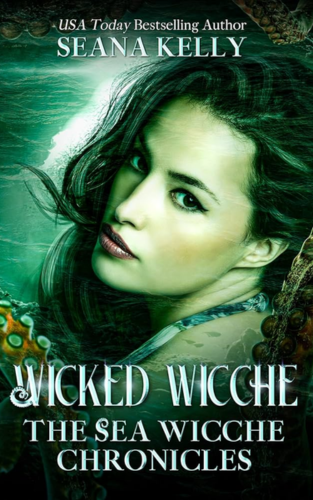
Wicked Wicche by Seana Kelly
Arwyn, our favorite artist and Sea Wicche, is trying unsuccessfully to deal with two new descriptors: murderer and mother.
The gallery is open, and the sorcerer is gone. Arwyn and the whole Corey clan should be celebrating. Instead, they’re mourning a huge loss and now dealing with the Council of Wicches over a poisoning.
Lessons have begun with Dad. All the things a little faeling should have already learned, Arwyn is now being taught. And just in time, as the queen—cryptically and rather terrifyingly—told Arwyn that she has plans for her.
While trying to juggle all of that, and work on a huge order of glass octopuses, Arwyn is also drawn into another deadly police investigation. Send Arwyn your good thoughts because she really needs a nap.
The Bite Breakdown:
QuicQuick Verdict
Wicked Wicche by Seana Kelly is the book where the Arwyn series fully matures. What began as an isolation narrative — a powerful woman alone by design — has become something more complicated and more interesting: a story about what it costs to let people in, and what you gain when you finally do. The pregnancy functions less as a plot device than as a pressure test, forcing every relationship and every tension already in play to declare itself. The result is warm, messy, and entirely earned.
At a Glance
- Genre: Urban Fantasy
- Subgenre: Paranormal Romance / Cozy Dark
- Trope: Fated Mates / Found Family
- Series: The Sea Wicche Chronicles Book #4, Sam Quinn World Book #17
- POV: First person, single
- Romance Focus: Established relationship deepening under pressure; high emotional intimacy, moderate-to-warm spice
- Tone: Warmly atmospheric with dark procedural undertones; dry humour throughout
The Premise (No Spoilers)
Arwyn Corey is a half-fae Cassandra wicche and glass artist living on the Monterey coast, pregnant by her werewolf Alpha mate Declan and still processing the events of the previous book — specifically, killing her sorcerer cousin to save her family. She runs a gallery, helps police with psychometric readings, and is slowly, cautiously learning what it means to have people who genuinely want to be in her life rather than use her.
The core tension in Wicked Wicche is not a single dramatic threat. It arrives in layers: a rival wicche family with black magic ambitions and a decades-old grudge, a serial killer case threaded through multiple police investigations, visions that keep arriving whether Arwyn wants them or not, and the ongoing negotiation between her fierce autonomy and Declan’s equally fierce protectiveness. The pregnancy accelerates all of it.
This is the fourth book in the Sea Wicche Chronicles and the seventeenth in the broader Sam Quinn universe, and Kelly writes it with the confidence of a series that knows exactly what it is.
What Worked
The emotional architecture is the strongest element here. Kelly locates Arwyn’s core wound not in danger but in the disorientation of being loved well— she has handled danger all her life — but the disorientation of being loved well. The early scene where Arwyn snaps at Declan, then retreats to examine her own reaction, is one of the best character passages in the series. She does not simply feel annoyed. She tracks the annoyance back through her history, naming exactly why care can feel like condescension when decades of being used as a weapon have trained you to read it that way. That kind of interiority is rare in the genre.
Uncle Bracken’s growth across this book is handled with great restraint. Kelly never announces it. She lets it accumulate in small gestures — a cheek kiss that surprises them both, a dinner invitation accepted with careful nervousness, a practical gesture made for someone else’s comfort before his own. His investment in the coming baby, and the quiet way he begins restructuring his life around the possibility of being useful to a child, is genuinely moving precisely because it is never sentimentalised.
The case work integrates more cleanly here than in earlier entries. The procedural threads feel like a natural extension of Arwyn’s gifts rather than an imposed structure, and the darkness of what she encounters is treated with appropriate weight. Kelly does not aestheticise violence. She shows its cost to Arwyn and moves forward.
The found-family ensemble is at its warmest and most functional. Faith’s induction into the Three, the growing bond between Arwyn and her mother Sybil, Uncle John’s tentative re-emergence from grief — each of these threads advances without crowding the others.
What Didn’t Work (or Might Not)
The book carries a heavy plot load. By the midpoint, Arwyn is managing rival wicche antagonists, an active serial killer investigation, a separate morgue case, a threat to someone in her extended family, an FBI interview, preparation for a high-stakes external confrontation, the physical demands of an accelerated pregnancy, and significant emotional fallout from a well-intentioned mistake by her father. Each strand is handled competently, but readers who prefer tightly focused narrative arcs over sprawling ensemble plots may find the density tiring.
Kelly sets up one relationship conflict in the second half with enough tension to deserve a longer resolution. The argument it generates is among the sharpest writing Kelly has done with this couple, and the speed at which she dissolves it — through external event rather than earned conversation — leaves some of that potential unspent.
The primary antagonist family, while entertaining, tips from menacing toward cartoonish in the later chapters. Their incompetence becomes the joke before the threat has fully landed, which mildly undercuts the stated stakes around the people Arwyn is trying to protect.
Romance and Relationship Dynamics
This is an established couple navigating something genuinely difficult: Declan’s nature as an Alpha is to close distance and protect, and Arwyn’s nature as a survivor of isolation is to resist anything that feels like control. Kelly does not resolve this tension by having one of them simply yield. The book works through it via negotiation, and the negotiation feels credible because both characters have violated the same principle they are arguing about. Neither gets to be entirely right.
The pregnancy functions as a crucible for this dynamic rather than a softening agent. Arwyn does not become more placid or deferential. She gets more volatile, more emotionally transparent, and more likely to crash up against her own contradictions. Declan, for his part, is protective without being controlling, largely because Kelly writes him as genuinely listening rather than performing patience. The emotional intimacy between them is grounded and specific — grounded in small domestic details and accumulated trust rather than grand declarations.
- Graphic psychometric visions of sexual violence and murder; these are recounted from the victim’s perspective and include assault, drowning, and death
- Child murder (historical, at a summer camp setting)
- Use of magic against animals; black magic rituals involving tortured animals
- Pregnancy and accelerated supernatural gestation
- Heavy emotional processing of grief, guilt, and survivor identity
- Family dysfunction and generational abuse within the Corey coven
Who Should Read This
This book rewards readers already invested in Arwyn and Declan, or who have at minimum read the previous Sea Wicche Chronicles entries. It will not function well as a standalone — the emotional payoffs depend entirely on accumulated context. The ideal reader tolerates a lot of plot moving simultaneously, likes their heroines loud and complicated, and wants found-family ensemble dynamics at least as much as romance. Anyone sensitive to depicted sexual violence or harm to animals should approach with care. Readers who enjoy urban fantasy with genuine procedural texture, wry humour, and heroines who earn their power rather than simply possessing it will find a great deal to appreciate here.
Final Verdict
Wicked Wicche by Seana Kelly is a satisfying, full-hearted instalment that builds meaningfully on everything the series has established. Arwyn remains one of the genre’s better heroines — genuinely competent, deeply flawed, and stubborn in ways that feel earned rather than performative. The book does not trim itself for easy consumption. The book runs busy, warm, occasionally noisy, and absolutely worth the investment for readers here for the long run.
Book Rating: 4 Stars
A dense, emotionally generous entry that earns its complexity without always managing its pacing.
Heroine Strength: 5 Crowns
Arwyn consistently demonstrates competence, self-awareness, and the rare ability to be wrong without losing her core — she tracks her own bad behaviour, names it, and corrects without flagellating.
Spice Rating: 2 Flames
The physical intimacy is present and warm but not detailed; the emotional heat between Arwyn and Declan does considerably more work than the explicit content.
The Price of a Gift, a Public Monster, and a Family Reckoning
The most painful thing Mac does in Wicked Wicche by Seana Kelly is something he means as a gift. Removing Arwyn’s mental walls to ease her vision work strips away a protection she built herself over decades, and the scene that follows reveals something the main narrative has been circling all book: autonomy over her own mind is not something Arwyn can negotiate on, even with someone she loves. That Mac returns, apologises without defensiveness, and repairs the damage with one deliberate gap left for practice is what makes him worth having in her life — but the scene earns its weight because Kelly does not let the apology erase what the violation cost.
The mayor reveal works as well as it does because Kelly has been building his profile through victim testimony the entire book, letting readers assemble the portrait before the name arrives. Monroe is not a dramatic monster — he is a careful, status-driven man for whom other people have never fully registered as real, and that specificity is more disturbing than spectacle would have been. The investigation remains unresolved at the book’s end, which is the right call; a tidy arrest would undercut how methodically he has insulated himself.
What makes the Margaret confrontation land is not the slap — it is Sybil opening the front door and waiting in silence while an entire branch of the family files out, after she had invited them hoping for reconciliation. The distance between that hope and that outcome is where the scene lives. Kelly does not editoralise it; she simply shows Sybil standing at the door until it closes, and lets the reader feel the weight of what has been permanently settled.