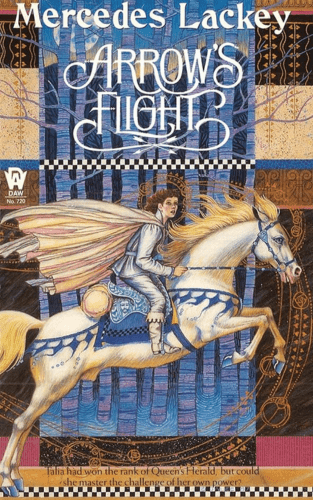
Arrow’s Flight by Mercedes Lackey
Talia could scarcely believe that she had finally earned the rank of full Herald. Yet though this seemed like the fulfillment of all her dreams, it also meant she would face trials far greater than those she had previously survived. For now Talia must ride forth to patrol the kingdom of Valdemar, dispensing Herald’s justice throughout the land.
But in this realm beset by dangerous unrest, enforcing her rulings would require all the courage and skill Talia could command—for if she misused her own special powers, both she and Valdemar would pay the price!
The Bite Breakdown:
Quick Verdict
Arrow’s Flight by Mercedes Lackey is a quieter, more inward sequel that trades spectacle for endurance. I find it compelling because it allows growth to hurt, stall, and continue anyway, without softening Talia’s struggle for reader comfort.
At a Glance
- Genre: Fantasy
- Subgenre: Epic Fantasy, Heroic Fantasy
- Trope: Reluctant Heroine
- Series: Heralds of Valdemar Book 2, Valdemar Book 29
- POV: Third Person
- Romance Focus: Subtle, emotionally restrained, secondary to personal recovery
- Tone: Earnest, somber, quietly hopeful
The Premise (No Spoilers)
Talia has earned her place among the Heralds, but survival does not bring peace. Instead, her new role exposes how much healing remains unfinished, especially when duty demands emotional availability she cannot yet offer. Training, missions, and expectations press inward, testing whether strength alone can carry unresolved pain.
Rather than escalating external danger, the narrative narrows its focus to Talia’s internal landscape. Responsibility, grief, and self doubt shape each decision, while moments of connection arrive cautiously and without promise. I appreciate how the story refuses shortcuts, allowing progress to remain uneven and sometimes frustrating.
As Heralds of Valdemar series book 2 and Valdemar book 29, this installment deepens the emotional spine of the world. It builds continuity through consequence, reinforcing that earlier events continue to matter long after their immediate resolution.
What Worked
The novel excels at honoring aftermath. Trauma does not vanish once danger passes, and competence does not erase vulnerability. I found Talia’s persistence convincing because it never masquerades as triumph, instead emerging through routine effort and quiet resolve.
Worldbuilding also benefits from restraint. Court politics, Herald hierarchy, and Companion bonds appear through lived experience rather than exposition. This approach strengthens immersion while keeping the focus firmly on character rather than lore accumulation.
What Didn’t Work (or Might Not)
Readers expecting momentum driven plot may find the pacing slow. The emphasis on emotional processing over action risks feeling static, particularly for those who prefer external conflict to guide engagement.
Romance remains deliberately minimal. While appropriate to Talia’s state of mind, it may disappoint readers seeking clearer relational development or payoff within this volume.
Romance and Relationship Dynamics
Connection exists here as potential rather than fulfillment. Trust grows incrementally, shaped by respect and shared purpose instead of attraction alone. I value how the story frames intimacy as something earned only when personal stability allows it, not as a cure imposed from outside.
- Trauma recovery themes
- Grief and survivor guilt
- Emotional withdrawal
Who Should Read This
This book suits readers who value character driven fantasy and emotional realism. It works best for those comfortable with slower pacing and narratives that prioritize healing over heroics.
Final Verdict
Arrow’s Flight by Mercedes Lackey reinforces that strength often looks like continuation rather than conquest. The book earns its quiet impact by refusing easy comfort, and I respect its commitment to emotional honesty.
Book Rating: 4 Stars
The character work carries lasting weight, even when the plot advances modestly.
Heroine Strength: 4 Crowns
Talia demonstrates resilience through choice and persistence rather than dominance.
Spice Rating: 1 Flame
Romantic elements remain understated and secondary to personal recovery.
When Preparation Fails the Gift
In Arrow’s Flight by Mercedes Lackey, duty repeatedly overrides healing, and the cost grows visible. The Heralds and the Collegium train Talia for a standard path that never fits her gift, treating her sensitivity as something discipline alone can manage. No one pauses long enough to question whether the system itself causes the strain.
That failure follows her onto the road during final field training. Without proper support, pressure compounds until control fractures in moments that carry real risk. The spiral exposes how institutional confidence can ignore warning signs, especially when success narratives demand silence and endurance.
Romantic possibility appears alongside this breakdown, then retreats. Attraction never resolves into comfort or rescue. Instead, the story insists that connection cannot substitute for readiness, leaving intimacy unfinished and deliberately out of reach.
(NOTE: This is the second novel/first series published in the Valdemar Universe, though the world itself does not require strict reading order. Each series stands on its own, allowing readers to enter at many points without confusion. That said, because later written series explore earlier periods in Valdemar’s history, a chronological read offers a fuller sense of how the world, its values, and its power structures evolve over time.)



Leave a Reply